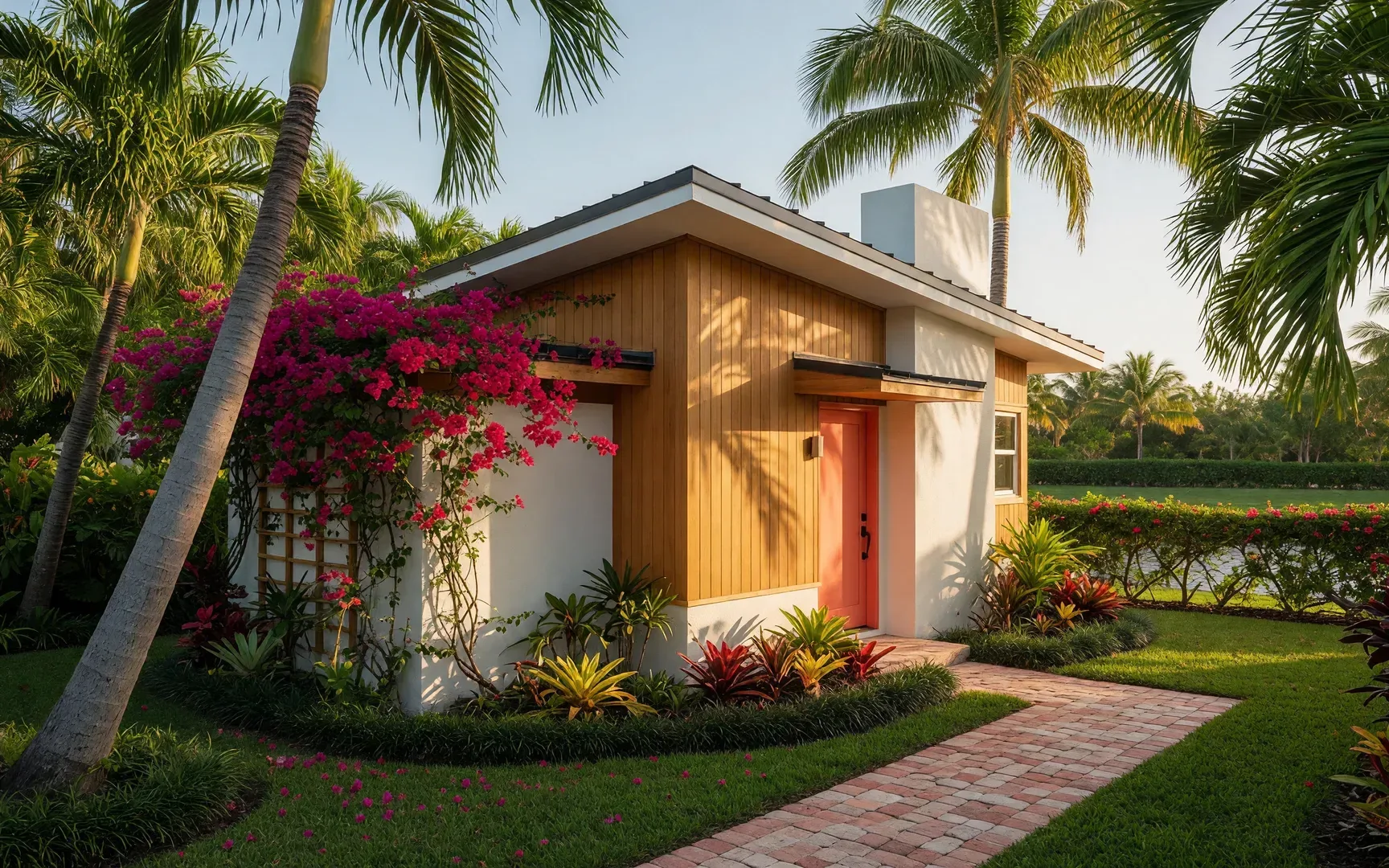
Accessory dwelling units, or ADUs, are a second living unit on the same lot as a single-family home, complete with its own kitchen, bath, and sleeping space, attached or detached. This guide is a practical look at what they are and why they matter in Boca Raton, Delray Beach, Highland Beach, Hillsboro Mile, and Gulf Stream, where rents run high and every lot is different. For homeowners, an ADU can mean rental income, a private place for family, or a genuinely more attainable housing option in one of Florida's highest-demand markets. For anyone relocating here, knowing how these units work can change how a property fits the life you are planning.
What an ADU is, and why they matter here
An accessory dwelling unit is a secondary living unit on the same lot as a single-family home, with its own kitchen, bath, and sleeping space. It can be attached to the main house, like a suite over a garage, or detached as a separate cottage toward the back of the lot. Florida cities and counties use different names for the same idea: accessory dwellings, accessory apartments, or accessory quarters. Whatever the label, the unit is a complete, independent home on a lot that already has one.
ADUs matter in Greater Boca Raton for three practical reasons. Rental income: on an owner-occupied lot, a well-placed unit can produce steady monthly rent in one of Florida's strongest markets. Family: an ADU gives parents, adult children, or an in-home caregiver a private, nearby place to live while the household keeps its own space. Attainability: in a market where single-family prices run high, a smaller separate unit on an existing lot is a more realistic home for a tenant or family member than a full-priced house.
What the 2026 Florida legislative session did not do
The major proposal was a statewide ADU mandate. HB 313 and its Senate companion SB 48 would have required every county and city in Florida to allow accessory dwelling units by right in all single-family residential areas, with local ordinances due by December 1, 2026. The Senate passed the bill 38-0, but it died in the Florida House on March 13, 2026. That is two years in a row the mandate failed to reach the Governor's desk.
The sticking point was vacation rentals. The Senate version allowed cities to require that an ADU rental be used as affordable housing, with lease terms of at least 30 days. House members wanted a more open short-term rental market, the two chambers never agreed, and the bill died when the House declined to take it up. Both bills' full text and vote history stay available on the Florida Senate's website.
What did pass: the fourth Live Local Act
The housing provisions that survived the session became CS/CS/HB 1389, the fourth Live Local Act, effective July 1, 2026. The ADU mandate did not survive with them. The result is clear: after 2026, Florida has no statewide right to build an accessory dwelling unit. Everything turns on the rules of the city or county where the property sits, and on the documents that govern the community.
The rules that actually apply in Boca Raton and the beach towns
State law sets the frame. Florida Statute 163.31771 authorizes local governments to allow accessory dwelling units in single-family residential zones. It does not require them. That single word, authorized rather than required, is why the answer to whether you can build an ADU always starts with where the property sits.
In unincorporated Palm Beach County, accessory quarters are permitted on owner-occupied single-family lots under Article 4.B.1 of the Unified Land Development Code. The general pattern is up to about 800 square feet of living area on lots under an acre, and up to about 1,000 square feet on lots of an acre or more, with additional limits on covered floor area such as porches and carports. The full text of Article 4 carries the use regulations and the fine print.
Inside the City of Boca Raton, the rules come from Chapter 28 of the city's zoning code and vary by zoning district. Setbacks, height, and design standards differ from one district to the next, so two lots a short distance apart can have genuinely different answers. Delray Beach, Highland Beach, Hillsboro Mile, and Gulf Stream each have their own codes as well, and each is read on its own terms.
One layer above zoning matters just as much: association covenants. In gated communities and country club neighborhoods, the governing documents can restrict or prohibit accessory dwellings and rentals even where zoning allows them. Buyers should read the declaration before counting on an ADU, because the association enforces its rules independently of the city or county.
How people use ADUs here, and what to plan for
- Rental income on an owner-occupied lot, from steady long-term leases to furnished seasonal rentals where local rules permit.
- Guest and in-law suites that give visiting family and aging parents independence without a second address.
- A private home office or studio, which many buyers treat as the deciding feature of a lot.
- Long-term affordable rentals that serve a real need in a market where attainable housing is scarce.
What to plan for: permitting and zoning review before construction, size and height limits, parking, separate utilities and metering, and insurance that covers a second dwelling on the property. None of these are reasons to skip an ADU, but all of them shape the timeline and the budget, and all of them are knowable up front with the right guidance.
ADU questions, answered
What is an accessory dwelling unit?
An ADU is a secondary living unit on the same lot as a single-family home, with its own kitchen, bath, and sleeping space. It can be attached to the main house or detached, and it functions as a complete, independent home. Florida cities and counties may call it an accessory dwelling, accessory apartment, or accessory quarter.
Are accessory dwelling units legal in Boca Raton?
Yes, with conditions that depend on exactly where the property sits. In the City of Boca Raton, Chapter 28 of the zoning code governs and the rules vary by zoning district, covering setbacks, height, and design standards. In unincorporated Palm Beach County, accessory quarters are permitted on owner-occupied single-family lots under Article 4.B.1 of the ULDC, generally up to about 800 square feet on lots under an acre and about 1,000 square feet on lots of an acre or more. Association covenants can add their own restrictions on top of that.
Did Florida pass a statewide ADU law in 2026?
No. The mandate in HB 313 and SB 48 passed the Senate 38-0 but died in the Florida House on March 13, 2026, the second year in a row. The housing bill that did pass, CS/CS/HB 1389, took effect July 1, 2026 without the ADU mandate. Local governments remain authorized to allow ADUs, not required to.
Can an ADU be rented out?
Short-term rental rules vary by locality, and they are enforced separately from zoning. The 30-day minimum affordable-housing rental provision in the failed Senate bill did not pass, so there is no statewide rule like it. Whether an ADU can be rented, and on what terms, depends on the city or county code and on any association covenants that apply to the lot.
Does an ADU change property taxes or the homestead exemption?
Renting out a portion of a residence can affect homestead treatment under Florida law, a point the Florida Supreme Court addressed in Furst v. Rebholz. The exact effect depends on how the property is used and how the local property appraiser records it. Anyone planning to rent an ADU should discuss the plan with a Florida tax advisor before signing a lease.
What size ADU can I build?
In unincorporated Palm Beach County, accessory quarters generally run up to about 800 square feet on lots under an acre and about 1,000 square feet on lots of an acre or more, subject to the ULDC and to limits on additional covered floor area like porches and carports. Inside Boca Raton, Delray Beach, Highland Beach, Hillsboro Mile, and Gulf Stream, the limits come from each city's own code.
Can my homeowners association restrict an ADU?
Yes. Covenants and declarations in gated communities and country club neighborhoods can restrict or prohibit both accessory dwellings and rentals, even where zoning allows them. The association enforces its rules independently of the city or county, so the declaration should be read before counting on an ADU.
The practical takeaway
ADUs are a genuinely useful option for Boca Raton homeowners, and after the 2026 session the rules turn on where the property sits, not on state law. A lot in unincorporated Palm Beach County, a lot inside the City of Boca Raton, and a lot governed by a country club declaration can each answer the same question differently. I help buyers and sellers understand what their lot allows, so the ADU conversation starts with the facts of the property rather than a headline. If you are researching a home or planning a change to one you already own, start with your address and we will map the local rules together.